How to Make a Diet Plan With Foods You Actually Like
11.17.2026
8 min read
16 views
Short answer: to make a diet plan with foods you actually like, work out your daily calorie target, list the foods you enjoy, split your calories across your meals, and then size each portion so the day adds up to your target. You do not have to cut out your favorite foods. You change how much of them you eat, not whether you eat them.
This guide walks through each step with real numbers, then shows a full 1,800-calorie day that includes two slices of pizza.
Why build a diet around foods you like?
Most diets fail for a simple reason: people stop following them. Strict plans built on foods you don't enjoy are hard to keep up for more than a few weeks, and the weight usually comes back once the plan is dropped.
Research backs this up. In a well-known randomized trial comparing the Atkins, Ornish, Weight Watchers and Zone diets, weight loss depended much more on how well people stuck to their diet than on which diet they followed (Dansinger et al., JAMA, 2005). A plan made from food you look forward to eating is simply easier to stick to.
Step 1: Find your daily calorie target
Your calorie target is the number of calories you can eat each day to reach your goal. To lose weight, you eat a little less than your body burns.
Estimate how many calories you burn per day (your TDEE) with the TDEE calculator.
Subtract a moderate deficit. Around 500 calories a day is a common starting point. The calorie deficit calculator shows what a deficit means for your timeline.
Most guidelines advise against going below roughly 1,200 calories a day for women or 1,500 for men without medical supervision.
For the example in this article we will use a target of 1,800 calories.
Step 2: List the foods you actually enjoy
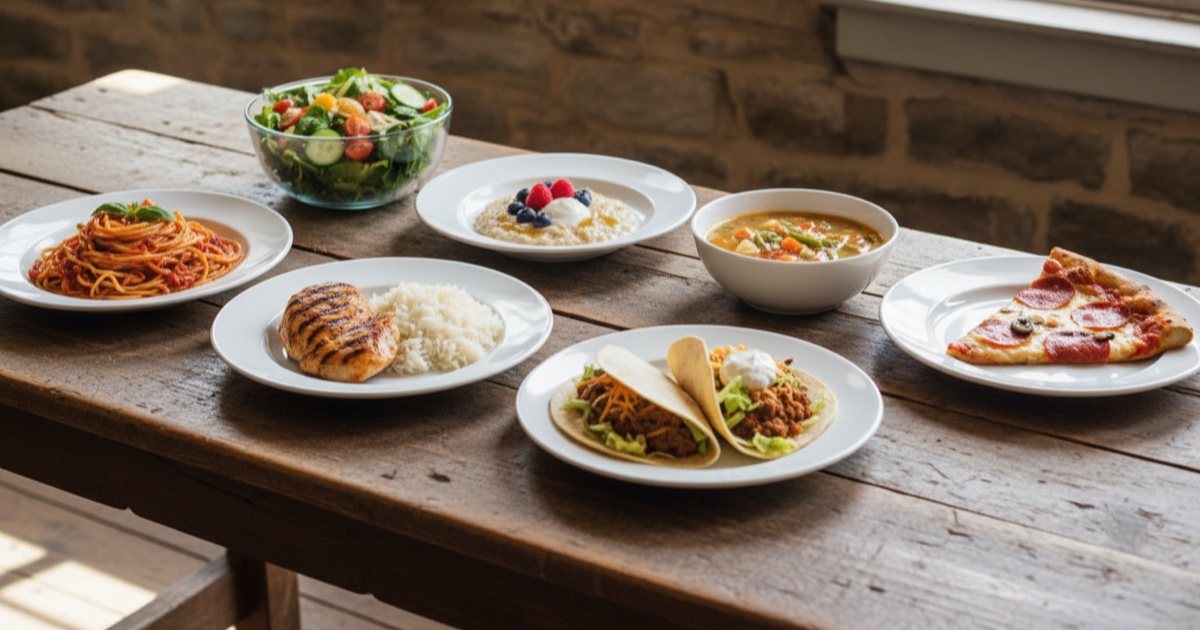
Write down foods you would happily eat several times a week. Aim for two or three choices in each group, so your plan has variety and still covers your nutrients:
Group
Why it matters
Examples
Protein
Keeps you full and protects muscle while you lose weight
Chicken, eggs, Greek yogurt, tuna, tofu, lentils
Carbohydrates
Your main energy source
Rice, pasta, bread, potatoes, oats
Fats
Needed for hormones and absorbing vitamins; very calorie-dense
Olive oil, nuts, cheese, avocado
Fruit and vegetables
Volume, fiber and micronutrients for very few calories
Apples, bananas, berries, salad, tomatoes
"Joy foods"
The reason you will stick to the plan
Pizza, chocolate, ice cream, burgers
Do not skip the last row. Planning a favorite food on purpose works much better than banning it and giving in to a craving later.
Step 3: Split your calories across meals
Divide your target between the meals you usually eat. There is no single correct split. Use one that matches your appetite and routine. For 1,800 calories, one simple option is:
Breakfast: about 450 calories
Lunch: about 550 calories
Dinner: about 650 calories
Snack: about 150 calories
Step 4: Size each portion to fit
This is the step most people skip, and it is what turns a list of foods into an actual diet plan. For each food, decide how many calories of the meal it gets, then convert that into grams:
Portion (g) = calories you want from the food ÷ calories per 100 g × 100
Example for a 550-calorie lunch of chicken and rice:
Chicken breast (cooked) has about 165 kcal per 100 g. For 250 calories: 250 ÷ 165 × 100 ≈ 150 g.
White rice (cooked) has about 130 kcal per 100 g. For 235 calories: 235 ÷ 130 × 100 ≈ 180 g.
The remaining ~65 calories go to a large salad with a teaspoon of olive oil.
Step 5: Check your protein
When you are eating fewer calories, enough protein helps you stay full and hold on to muscle. A range of about 1.2 to 1.6 g of protein per kilogram of body weight is commonly recommended during weight loss. For a 75 kg (165 lb) person that is roughly 90 to 120 g a day. The protein calculator gives a personal number.
If you come up short, make the protein foods you like a bigger part of each meal and shrink the carb or fat portions to make room.
Example: an 1,800-calorie day built from foods you like
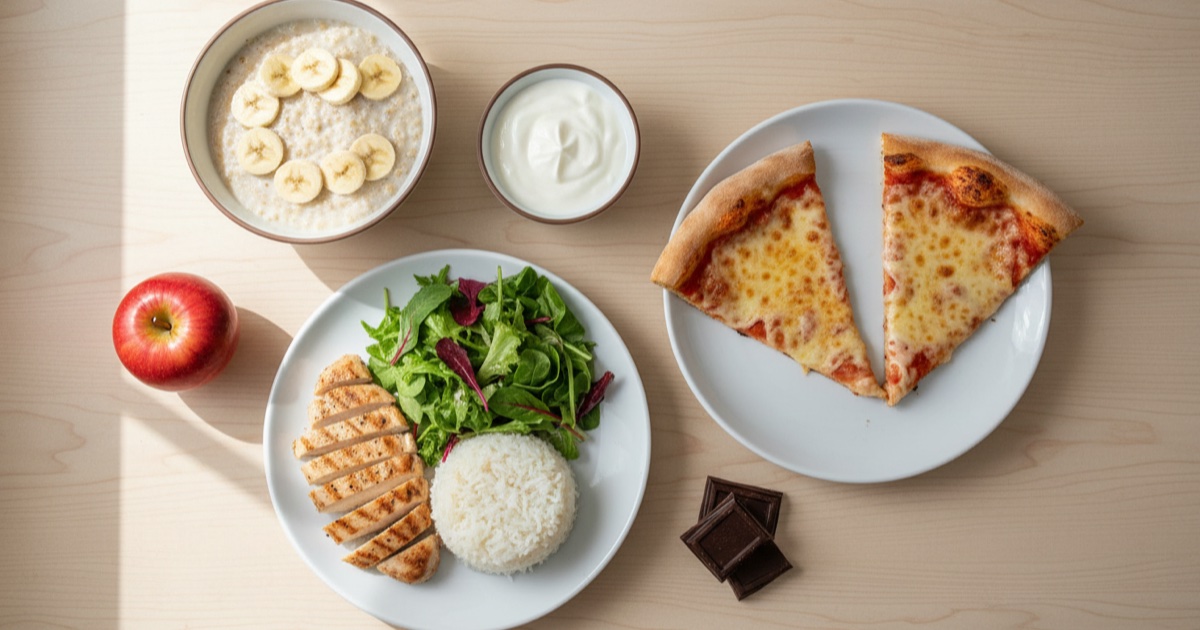
Here is a full day for someone whose favorite foods include oatmeal, chicken and rice, pizza and dark chocolate:
Meal
Food and portion
Calories
Breakfast
Rolled oats, 60 g dry (about ⅔ cup)
227
1 medium banana (118 g)
105
2% Greek yogurt, 150 g
110
Lunch
Chicken breast, cooked, 150 g (about 5 oz)
248
White rice, cooked, 180 g (about 1 heaping cup)
234
Mixed salad, 150 g
30
Olive oil, 1 teaspoon
40
Dinner
2 slices of cheese pizza (large 13–15-inch, regular crust, about 119 g each)
633
Side salad, 100 g
20
Snack
1 medium apple
95
Dark chocolate (70–85%), 10 g
60
Total
≈ 1,800
This day provides about 106 g of protein, which sits inside the 90–120 g range for a 75 kg person. Calorie values are typical averages based on USDA FoodData Central. Brands and recipes vary, so treat them as close estimates.
What if your favorite foods are high in calories?
You can still keep them. A few ways to make them fit:
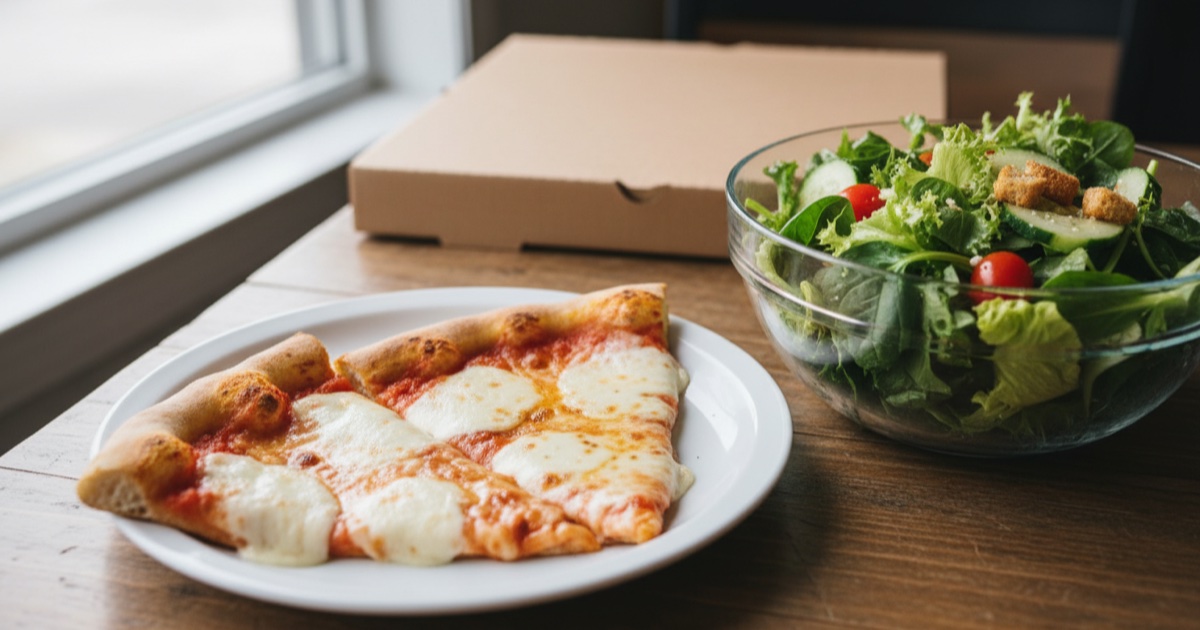
Eat a set portion: two slices of pizza fit into the day above, while half a pizza would not.
Add filling, low-calorie food alongside: a salad or vegetables next to a calorie-dense meal makes a smaller portion feel like enough.
Plan it for certain days: pizza twice a week is easier to budget for than pizza every night.
Balance the rest of the day: a lighter lunch leaves more room for a bigger dinner.
Doing it automatically with EatLog
Working out portions by hand for every meal takes time, and it is the main reason people give up on meal planning. EatLog builds a meal plan from foods you actually like, with portions sized to your calorie target. You pick your foods from the list, and EatLog works out the portions and builds the plan around them. If you eat something that is not on the plan, take a photo of the plate and EatLog estimates the calories and macros and logs them for you.
Yes. Weight loss depends on eating fewer calories than you burn, not on cutting out specific foods. If your favorite foods are portioned to fit your daily calorie target, you can keep eating them and still lose weight.
How many foods should I pick for my diet plan?
Two or three from each group (protein, carbohydrates, fats, fruit and vegetables) plus one or two favorite treats is enough to build a varied plan you can repeat.
Do I need to weigh my food?
Weighing food for the first week or two helps you learn what a portion looks like. After that, most people can estimate portions by eye or with a photo-based tracker.
Is there an app that builds a diet plan from my favorite foods?
Yes. EatLog lets you pick the foods you like from a list and sizes the portions to your calorie target, so your meal plan is made of food you already enjoy. Meals that are not on the plan can be logged with a photo.
This article is general information, not medical advice. If you have a health condition, are pregnant or take medication, talk to a doctor or registered dietitian before changing your diet.
Yes, if the portion fits your calorie target. Here are the calories in a slice of pizza by crust and topping (USDA data), how many slices fit into a dinner, and how to keep pizza night in your week.
We compared EatLog, Fitia, Eat This Much, Mealime and MyFitnessPal on one question: can you build a meal plan from foods you actually like, with portions that fit your calorie target?
Low-carb, low-fat, Atkins, Zone: large studies find only small differences between diets. What predicts weight loss is whether you keep following the diet. Here is the evidence and how to use it.
We use cookies to improve your experience, analyze website traffic, and provide personalized content. You can accept all cookies or manage your preferences. Privacy Policy
Cookie Settings
Choose which cookies you allow. You can change this at any time.
Required for core site functionality such as page routing, language selection and security. These cannot be turned off.
Cookie table
Cookie
Type
Expiration
PHPSESSID
Native to PHP. Stores the session identifier used for contact form rate limiting and spam protection.
Session
eatlog_cookie_consent
Stores your cookie preferences so this dialog is not shown again on your next visit.
6 months
eatlog_lang
Remembers the language you picked from the language menu, so the home page takes you to that version. Only set when you choose a language.
6 months
Help us understand how visitors use the site so we can improve it. Includes Google Analytics.
Cookie table
Cookie
Type
Expiration
_ga
Google Analytics. Distinguishes visitors by assigning a randomly generated identifier.
2 years
_ga_T9F0K4TDT0
Google Analytics. Persists session state so visits can be measured for this property.
2 years
Used to measure campaign performance and show more relevant ads.
Cookie table
Cookie
Type
Expiration
_gcl_au
Google Ads. Measures ad conversions, i.e. whether a visit that came from an ad ended in a download.
90 days
_gcl_aw
Google Ads. Stores the click identifier of the ad that brought you to the site.
90 days
Remember your choices, such as preferred language or interface settings.
Cookie table
This category does not currently set any cookies on this site.